Data delivers the finding. People deliver the judgment.
CineCockpit gives producers and production companies the structured data foundation that broadcaster meetings, funding applications, and financing rounds require today. Every project and concept is cross-referenced against public registers and open sources. Six data blocks per title, a market query at the push of a button, every statement with source and date.
Evaluating a submitted package today means drawing on experience, calling contacts, and searching the web. That is slow and full of gaps. Knowing which tones and milieu combinations are currently saturated or represent open territory in Europe market leads to better decisions.
Naming comparables, building the audience argument, contextualizing market potential: what counts as preparation on the other side of the table costs days internally and often rests on a handful of undated sources. A substantiated data sheet changes the dynamic in the room.
Funding panels and co-producers expect market context. Demand signals, white-space analysis, comparable titles with their distribution path: presenting this in a structured way rather than asserting it puts you in a different position in the conversation.
CineCockpit accompanies the development process from the first story draft through to the finished pitch package. Screenplay and material analysis, cross-referencing against public databases and industry registers, comparison with related distribution paths: all within a single workflow.
Theme, tone, milieu, and format class of a project are matched against public title registers and industry metadata. The result is a structured first reading: what is related, what is similar, where the field is crowded, where it is open.
Every query, every cross-reference, and every annotation enriches the data sheets of the titles and creatives involved. The living sheet of a project grows denser, more precise, and richer in comparables the more it is used in the workflow. No extra effort required.
Every title in Europe catalogue can be queried across six structured layers. Each answer carries a source indicator, a retrieval date, and a confidence rating.
Title, genre taxonomy, year, runtime, country of production, premiere or theatrical release, language version, format class. All normalized to a unified schema that allows direct comparison.
Theatrical performance data (releases, run, admissions from public corpora), TV placement, known streaming windows. Data-backed forecast promise, only a documented record with source references.
Aggregated audience ratings from public platforms, sentiment direction from critic corpora, resonance indicators from search interest signals. Not a social listening replacement, but a substantiated first impression.
Track record, genre patterns, and tone profile of directors, writers, or key creative positions from public sources. Helps position packaging decisions in conversations with partners and funding bodies.
For projects with a literary source, remake basis, or franchise connection: adaptation history, rights status indicators from public sources, and comparison with related distribution paths in Europe market.
Publicly known productions in development or announced distribution with a similar tone or theme profile. Not an intelligence tool, but an early overview of visible competition.
All six data blocks can be retrieved via chat query for a specific title. Every statement carries a source indicator, retrieval date, and confidence class (high / medium / low). No fabricated findings.
CineCockpit connects an extensible collection of open data sources, industry registers, platform signals, social APIs, communities, and databases. No data monoculture: sources and connections are neutrally named, interchangeable, and extendable. Using one source today does not create a dependency on it tomorrow.
Public title and metadata registers, open knowledge graphs for entity resolution, demand and search interest signals, reach and resonance signals from public platforms, and theatrical performance corpora for DACH and the EU. Every source is named and dated.
The system runs on EU infrastructure. AI models are interchangeable and can be operated locally. Data sovereignty stays with the customer. GDPR compliance is architecture, not an afterthought. Anyone who needs to protect sensitive projects and concepts in development will find the right foundation here.
A single chat question is enough to set demand signals (search interest, resonance indicators) alongside the supply side (currently visible productions in that segment). The result shows where demand and supply diverge.
"How does demand compare to available supply for coming-of-age dramas set in rural environments in Europe market, 2022 to present?"
No finding without origin. Every statement from CineCockpit carries a structured source indicator with source type, retrieval date, and confidence class. This allows arguments in a broadcaster meeting or funding application to be anchored without needing to look up the raw source yourself.
"Coastal milieu dramas with a coming-of-age core are represented in Europe cinema 2022-2026 with fewer than five publicly documented titles."
The path from raw data query to a substantiated argument for a broadcaster meeting or funding application is direct in CineCockpit. No export to intermediate systems, no manual assembly. The data sheet is the argument.
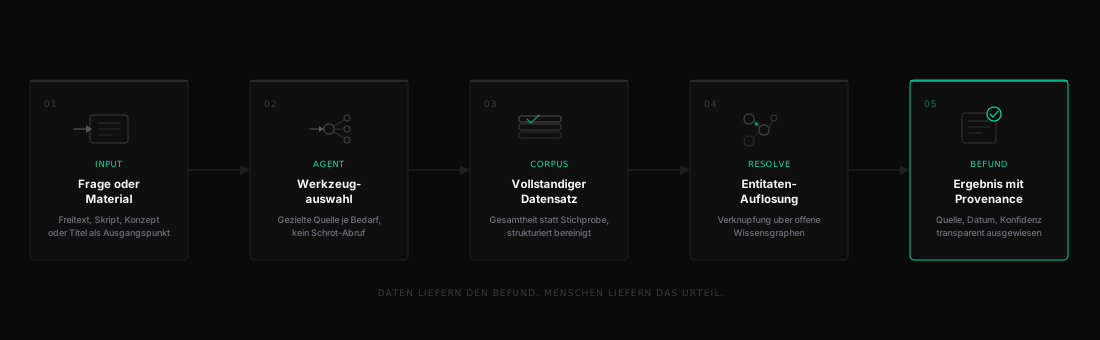
A typical workflow for a production company preparing a broadcaster meeting and a funding application in the same week.
Enter title and genre tags. CineCockpit immediately pulls available master data from public title registers and creates the living sheet. All six data blocks are queryable from this point on.
Chat query for comparable productions within the defined tone and milieu corridor. The response lists titles with production year, premiere, and tone overlap. Every statement carries a source indicator and retrieval date.
Demand and supply query for the specific segment. Where is supply thin despite existing demand signals? The result is the funding and financing argument: not a claim, but a documented finding.
Brand analysis of key creative positions from public sources: track record, genre patterns, known pipeline projects. Does the packaging tell a consistent story that can be argued with evidence?
Broadcaster meeting, funding panel, financing round: the living sheet is ready, the comparables are documented, the white-space argument is backed by source and date. The judgment and the decision remain yours.
Quickly contextualize a submitted package: is the tone saturated or open territory? Identify comparable productions. Decision basis in minutes, not days.
Demand-supply query for a theme or tone segment. Where is Europe offering thin? Where do demand signals meet little visible production? White space as a starting point for development.
All six data blocks for one title: master data, commercial performance, sentiment, creator profile, adaptation comparables, pipeline. For slate decisions and comprehensive individual analyses.
"The argument lands differently when it does not come from me but from documented data. You notice the difference at the latest when the other side starts asking follow-up questions."
Producer, independent production company, DACH
Pilot user, Summer 2026
CineCockpit draws from an extensible collection of open data sources and industry registers, provider-neutral and interchangeable. No data monoculture, no lock-in.
View the data basis in detailIn a 30-minute live session we show how CineCockpit works with a concrete package from your own pipeline. Not a demonstration, but an actual workflow.
Availability: For development and editorial teams in Europe market. From filmmakers and writers to production companies, studios, broadcasters, and streaming services.