INPUT
Idea and Screenplay
Free text, treatment, screenplay, or concept as the starting point.
CineCockpit is not a single tool but a continuous process in six steps. Story in, market findings and marketing approach out. Each module solves a concrete task, from the first treatment through to a data-grounded channel recommendation. Data delivers the findings. People deliver the judgment.
WORKFLOW // END-TO-END STREAMLINE
Six steps. One continuous process. Data delivers the findings. People deliver the judgment.
INPUT
Free text, treatment, screenplay, or concept as the starting point.
ANALYSIS
Extraction of genre, tone, characters, and format parameters.
MATCHING
Structured matching against open sources and audience signals.
PROPRIETARY AI
EU infrastructure, interchangeable and self-hostable. No third-country dependency.
FINDINGS
Comparable titles, audience match, and sourced evidence with confidence levels.
OUTPUT
Actionable recommendation for digital channels, grounded in market findings.
The asset library is the central archive for all stories, talent, creatives, literary rights, and active projects within an organisation. Everything in one place, searchable, filterable, and with a clear edit history. It forms the foundation for every screenplay and story analysis carried out in the system.
Rather than scattering knowledge across email folders, spreadsheets, and personal notes, the team maintains a shared body of work. When onboarding a new colleague or reactivating a project, all information is immediately at hand, complete with source attribution and timestamps. With each run, the data records grow richer.
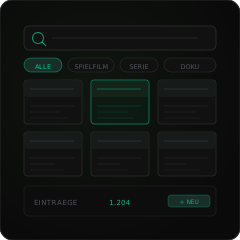
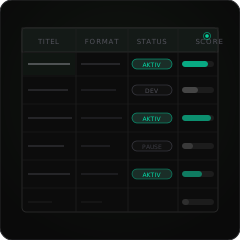
Every entry in the library is not a static form but a living data record. When first created, it is automatically populated with publicly available information and updates whenever new data becomes available. The system draws on an extensible collection of open sources and data providers, provider-neutral and interchangeable.
This saves hours of manual research. Every automatically entered piece of information carries a source, a date, and a confidence level. Insights from the intelligence chat flow directly back into the sheet, so that each record grows more complete with every use. The flywheel principle: the more the team works, the richer the data records become.
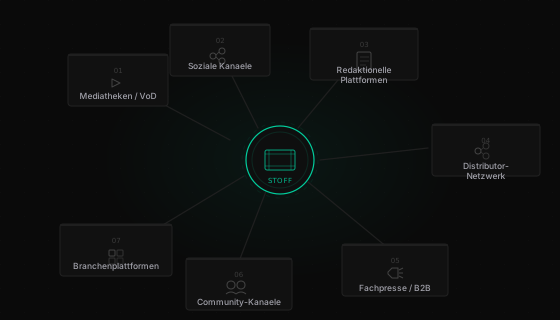
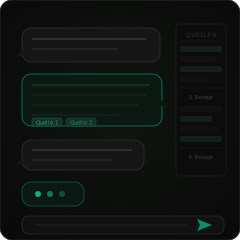
A research interface that works directly on an organisation's own data and on an extensible collection of open data sources. CineCockpit connects a range of interfaces: social platforms, streaming catalogues, community data, and knowledge graphs, named neutrally and without vendor lock-in. Questions are not just answered, they are substantiated with source, date, and confidence level.
Data delivers the findings. People deliver the judgment. The chat is not a decision-making machine but a tool for the development of stories and creative concepts, one that makes every statement traceable. The underlying language model is interchangeable, with no lock-in to any single provider.
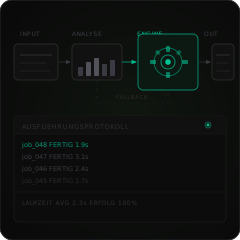
Running in the background is an agentic processing pipeline: it takes a request, pulls in relevant data sources, checks for conflicts, enriches the record, and produces a structured output with a complete provenance chain. Stories and concepts are matched against databases and open sources throughout.
This is not a black box. Every step of the workflow is logged and traceable. The engine can be adapted to the existing working environment of any organisation, including custom taxonomies, operating modes, and export formats. All connected interfaces are provider-neutral and can be swapped out.
OPERATING MODE 01
Discovery
Broad exploration: mapping stories, talent, or topics from the library and public sources.
OPERATING MODE 02
Validation
Targeted verification: market positioning, sourcing comparables, confirming rights status and funding history.
OPERATING MODE 03
Deep Mining
In-depth analysis: all six data categories combined, exportable dossier with complete provenance.
CineCockpit draws on an extensible collection of open data sources, provider-neutral and interchangeable. Stories and concepts are matched against these sources and automatically annotated with evidence. No date, no value appears without a source reference. That is the provenance principle.
01
Public film and TV registers supply base data on titles, casts, production years, and technical specifications.
02
Entity resolution via open knowledge graphs links people, works, and organisations in a machine-readable and unambiguous way.
03
Aggregated search-interest data shows which topics, genres, and stories are gaining attention in Europe market.
04
Reach and resonance signals from public platforms provide indications of audience interest and format affinity.
05
Streaming demand indicators reveal which stories and genres are gaining traction in international comparison.
06
Public review and community corpora (GDPR-compliant, no personal raw data) enable sentiment classification.
Screenplays, stories, and rights options are the most valuable asset in any development process, whether in the writers' room, in production, or in a broadcaster's editorial team. CineCockpit was built from the ground up to ensure that this data never leaves the organisation. EU hosting, GDPR compliance, data sovereignty: Europe-first with local AI.
Each organisation receives a strictly separate database and runtime environment. No shared tenancy, no shared vector indexes, no cross-connections between customers.
All data resides on certified servers within the EU. No transfer to third countries without explicit authorisation and a corresponding data processing agreement.
The AI model is modular: no vendor lock-in. Switching between providers or running a locally hosted model are both contractually and technically supported.
Requests to external language models are not stored for training or logging purposes. This is contractually guaranteed and explained in the security demo.
At the end of the streamline sits not a pitch document but a data-grounded marketing approach: relevant audiences, fitting digital channels, recommended timing, and campaign patterns drawn from comparable titles. CineCockpit derives this recommendation directly from the market findings, not from instinct.
The system identifies which audiences are relevant for a given story, through which social and community channels those audiences have been reached by comparable works, and which timing patterns proved effective. Everything is a finding and a suggestion. The decision belongs to the team. No invented numbers, data-backed box-office guidances, no automatic greenlight promise.
SAMPLE OUTPUT // MARKETING FINDINGS
25-44, urban, series-literate. Affinity with European thriller stories with historical grounding (comparables: Babylon Berlin, Charite).
History and true-crime communities, book-focused social formats, contemporary history podcast circles. Secondary: public-broadcaster press corridors and editorial platforms.
Autumn window (Sep-Nov) disproportionately strong for prestige mini-series in DACH. Community seeding lead time: 8-12 weeks before release.
High, based on 14 comparable titles. Source attribution in the dossier.
Which online communities and platform formats fit the story and its audience. Derived from resonance signals of public channels, not from advertising platform data.
Seasonal patterns and lead times from public release data of comparable titles in the European market. A historical finding, not an algorithmic optimum.
Structural similarities to releases such as The Swarm (2023) or Kleo (2022) as a frame of reference. With source attribution and confidence assessment.
GENRE TAXONOMY
CineCockpit uses its own DACH-specific genre taxonomy. Instead of broad categories like "drama" or "thriller," it offers precise micro-genres that reflect the real language of development conversations. The taxonomy grows with each use and is maintained with AI support.
PILOT PHASE // AUTUMN 2026
In a 30-minute demo we walk through the entire streamline from story input to marketing approach, using titles and questions from your own context. For filmmakers, producers, studios, broadcasters, and streaming providers in Europe.
AVAILABILITY: FOR DEVELOPMENT AND EDITORIAL TEAMS IN THE EUROPEAN MARKET. FROM DIRECTORS AND WRITERS TO PRODUCTION, STUDIOS, BROADCASTERS, AND STREAMING PROVIDERS.