
Programme Analysis and Format Trends for Studios and Streaming Providers
Data delivers the finding. You deliver the verdict.
Many projects in parallel, tight decision timelines, high confidentiality requirements: CineCockpit gives editorial and development teams structured market and resonance data directly within their workflow, in a dedicated instance that belongs exclusively to your organisation. Each analysis enriches the internal data sheets, and the system becomes more reliable with every run.
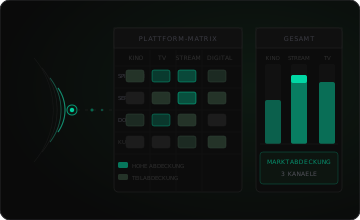
Three gaps almost every editorial team knows
No pipeline overview
Who is developing what, at which stage? Information lives in email folders, pitch decks and the heads of individual team members. A complete picture of the current slate only emerges in the meeting itself, not before it.
Demand and resonance signals are unstructured
Search interest, platform resonance, chart movements: the data exists, but it is scattered across sources and not in a format that editorial teams can use directly. Aggregating it manually takes hours per project.
White space in Europe market stays invisible
Internationally oriented databases are built around English-language markets. DACH-specific market gaps, genre fields and audience shifts barely surface there. Independent research remains structureless.
From story and concept development to a substantiated finding
CineCockpit is not a reporting dashboard that outputs static tables. It is a tool for the active development of stories and creative concepts. Each query matches your project against databases and open sources, cites every statement with its origin, date and confidence level, and enriches the data sheet for the next use.
Create a project or concept
Enter a logline, tone, genre tags and development stage. Optionally import an expose or treatment directly. The system immediately connects the material to the current DACH inventory drawn from public work and metadata registries as well as open knowledge graphs.
Market query via chat
Ask questions such as "Which crime formats with a female lead aired in Europe over the past four years and how were they received?" The system aggregates connected social platform APIs, community corpora and industry databases, and cites every figure with source, date and confidence level. The AI provider is local or interchangeable.
"Which DACH crime formats from the past four years share tone and broadcast-slot profile with this concept?"
Flywheel principle: each use strengthens the foundation
Every query enriches the project's data sheet. Demand signals, comparable references, audience indicators: what appears as a raw finding on the first run becomes more precise with each subsequent use. The system does not learn across organisations -- it consolidates internally.
All entries carry source and date. No data point without a provenance reference.
A structured foundation for every slate decision
Portfolio view in a single interface
All active projects as living asset sheets, with development stage, assigned talent and linked market data. New team members get up to speed immediately. No knowledge is lost when staff changes.
Competitive landscape and pipeline view
Comparable projects in the public development pipeline, casting density within a genre, known licence windows: the system pulls together public work and metadata registries alongside open knowledge graphs and surfaces overlaps or gaps.
Export-ready dossier
Every asset sheet and every chat response is exportable as a structured dossier: for internal committees, funding discussions or production partners, always with a complete source reference.
Demand and resonance signals per project
Search interest curves, reach and resonance signals from connected platform APIs and communities, as well as streaming demand indicators, are aggregated per asset sheet. The interfaces are provider-neutral and interchangeable. No separate research tool, no manual aggregation.
Finding white space
A microgenre taxonomy with over 80 DACH-specific tags, matched against production data and audience resonance: CineCockpit shows which genres are undersupplied in Europe market and which format niches remain unoccupied.
Screenplay and material analysis within the workflow
Incoming treatments or exposes can be read in directly and matched against Europe inventory. The analysis surfaces tone, comparables and market context without any manual pre-sorting.
Six categories. One extensible data foundation.
CineCockpit connects an extensible collection of open data sources, social platform APIs, community corpora and industry databases -- provider-neutral and interchangeable. No lock-in to a single data vendor, no proprietary data silo.
Public work and metadata registries (film/TV)
Title, cast, crew credits, production year, country of origin, format.
Entity resolution via open knowledge graphs
Unique identifiers for projects, persons and companies, linkable across sources.
Demand and search interest signals
Time series of audience interest per project and genre, normalised for DACH.
Reach and resonance signals from public platforms
Aggregated engagement and reach values, GDPR-compliant, no personal raw data.
Streaming demand indicators
Cross-platform demand corpora for DACH and selected EU markets.
Public review and community corpora
Critical and reception data, GDPR-compliant, no personal raw data.
All data points carry source, date and confidence rating. No data point without a provenance reference.
Where CineCockpit is put to work
Before the pitch meeting
Contextualise incoming projects within minutes: comparables from public registries, resonance signals for the genre, market landscape in Europe. The meeting starts with substance, not open questions.
Placing genre and tone
Where does a project sit within Europe microgenre taxonomy? Which broadcast or platform contexts have comparable formats found? CineCockpit provides the structured framing without pre-empting the judgement.
Preparing an acquisition decision
Known exploitation history of a title or format, adaptation rights landscape in the knowledge graph, resonance in comparable markets: all relevant data points in one dossier, ready for export.
Making arguments verifiable
Corpora for DACH and EU comparison markets, funding history of comparable projects, target audience resonance: CineCockpit prepares arguments that hold up in funding discussions and co-production negotiations, because they carry source and date.
Your instance belongs only to your organisation
Scripts, projects and pitch materials are the most sensitive assets in development. CineCockpit operates a fully separate database instance on EU infrastructure for each organisation. No shared tables with other clients, no central data warehouse.
The system operates Europe-first with local AI: all data stays within the EEA, local AI models can be deployed, and the LLM provider is interchangeable without data migration. Zero-retention by contract: queries are not used for model improvement, and no provider analyses your projects.
View the security architecture in detailIsolated instance per organisation
Strictly separate database. No data point leaves your instance.
EU hosting, GDPR-compliant
All data stays within the EEA. No transfer to third countries.
Zero-retention by contract
Queries and content are not used for model training.
Local AI models possible
LLM provider is interchangeable. Full operation on your own infrastructure is possible.
"We go into pitch meetings with concrete data points we had beforehand. Not with gut instinct, not with an hour of follow-up research afterwards."
Head of Development, DACH broadcaster
Pilot use, Summer 2026Get to know CineCockpit in 30 minutes
In a live session we show you how CineCockpit handles your specific projects and questions: market query, resonance signals, portfolio view, privacy architecture. Not a presentation -- a genuine working session.
AVAILABILITY: FOR DEVELOPMENT AND EDITORIAL TEAMS IN THE DACH REGION. FROM DIRECTORS AND WRITERS TO PRODUCTION, STUDIO, BROADCASTER AND STREAMING.